Here is a link to a screencast I created using Jing.
Water Cycle Screencast
Saturday, December 20, 2014

Sunday, December 14, 2014
Podcast for the Water Cycle
Listen to the podcast. While you are listening to the podcast, see how many vocabulary words you can identify!
References:
Soundsnap. (2008-2014).Rain Cement Splashy 01 CRussomFX. Retrieved from http://www.soundsnap.com/search/audio/rain+cement/score 12/13/14
Soundsnap. (2008-2014) Rocky beach. Retrieved from http://www.soundsnap.com/search/audio/seagulls/score 12/13/14
Soundsnap. (2008-2014). Brook Gentle JO. Retrieved from http://www.soundsnap.com/search/audio/brook/score 12/13/14
Soundsnap. (2008-2014). Pool 3000 Close. Retrieved from http://www.soundsnap.com/search/audio/kids+playing+pool/score 12/13/14
References:
Soundsnap. (2008-2014).Rain Cement Splashy 01 CRussomFX. Retrieved from http://www.soundsnap.com/search/audio/rain+cement/score 12/13/14
Soundsnap. (2008-2014) Rocky beach. Retrieved from http://www.soundsnap.com/search/audio/seagulls/score 12/13/14
Soundsnap. (2008-2014). Brook Gentle JO. Retrieved from http://www.soundsnap.com/search/audio/brook/score 12/13/14
Soundsnap. (2008-2014). Pool 3000 Close. Retrieved from http://www.soundsnap.com/search/audio/kids+playing+pool/score 12/13/14
Tuesday, December 2, 2014
Digital Flashcards
Here is a link to vocabulary terms for Unit 3: The Water Cycle. Click on the link and either click on the slides or run the presentation.
https://docs.google.com/presentation/d/1HbZTmAj5ABmKa6THepYeZ4Yb2aLSYxASuSQ_j-sSzkg/edit?usp=sharing
Thursday, November 27, 2014
PowerPoint Video
I was able to successfully download and convert the water cycle rap video and insert it into a power point slide! It will be interesting to see if it will work around our filters at school! Youtube is blocked by our server for students and teachers have to password in to access them.
Water Cycle Video
This video is for those who want a quick tour of the water cycle. I also embedded it in my previous lesson post since it went with what is being taught in it, but I posted it here for those who don't want to go through my lesson blog to find it. It's a fun, catchy rap which I hope will stick in the minds of my fifth graders! I will have to point out that precipitation is spelled with a "c" not an "s."
Cottenham, A. (2011). The Water Cycle Rap HD! Retrieved from https://www.youtube.com/watch?v=815RUEMdLqM 11/26/14.
Cottenham, A. (2011). The Water Cycle Rap HD! Retrieved from https://www.youtube.com/watch?v=815RUEMdLqM 11/26/14.
Monday, November 17, 2014
Water Cycle Lesson
California State Science Standards covered in this lesson
Science Standard 5.3 Water on Earth moves between the oceans and land through the processes of evaporation and condensation.
Science Standard 5.3.b Students know when liquid water evaporates, it turns into water vapor in the air and can reappear as liquid when cooled or as a solid if cooled below the freezing point of water.

Science Standard 5.3.c Students know water vapor in the air moves from one place to another and can form fog or clouds, which are tiny droplets of water or ice, and can fall to Earth as rain, hail, sleet or snow.

Introduction
Welcome to your exploration of the water cycle. You will be learning about how water constantly moves through the air and land in a process called the water cycle. You will be working in groups of three for this lesson. So to start with, you will do a vocabulary activity so that you and your partners can use the same terms during your discussions and work. Begin with the flashcards, then you can go through the other modes.
Video:
Time to watch a video!
Task
You and your partners will be doing a series of activities on the water cycle as well as building your own model in the experiment portion of the lesson. Once you have completed these activities, you will create something to demonstrate the phases of the water cycle. I am including some choices for you. You may also create something that you and your partners have decided on so long as you ask and receive approval from me.
- A poster of the water cycle with each phase labeled with a description of what happens during that phase.
- A Google presentation with one slide for each phase and a description of that phase you should include pictures, filtered for free use, in your presentation.
- A diorama showing each phase.
- A diagram of the water cycle with each phase labeled and a description of what happens in that phase.
- A movie using Movenote and your pictures from the experiment portion of this lesson.
- A three dimensional model of the water cycle showing each phase.
javascript:void(0);
Resources
Discovery Education Water Cycle
Chromebook and Chromebook camera
Google document
Possibly Google presentation and the Movenote app
Process
You will start with a puzzle and interactive video on the water cycle by clicking on the link. Discovery Education Water Cycle
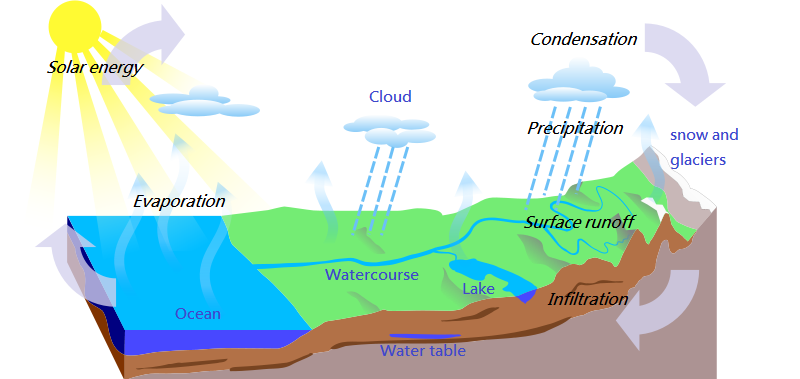
Now, take a look at this interactive diagram by clicking on the link. Water Cycle Diagram
Let’s do an experiment. Follow the link to the experiment. You need to use your Chromebook to take pictures for each step of the building of your mini water cycle. Once it has been built, you need to take pictures every 5 minutes. You will also be typing in your observations on a Google document. One of you create the document, then share it with the rest of your group and with me so that I can share it with the rest of the class. Each time you take a picture, record what you see in the Google document. Each of you needs to chose a different color so I can see who typed in their observations. (30-35 minutes) Mini Water Cycle
How much have you learned? Quick Quiz
Create your final project. Choose from the six possible ways to demonstrate your learning from the Task section above, or come up with something of your own so long as you remember to clear it with me first.
Extra Resources
These are some resources you may want to look at when you have finished the lesson.
Rubric
4
|
Completed all parts of the lesson with detailed Google document with pictures from the experiment. Final task shows all components of the water cycle with obvious attention to detail and explanation.
|
3
|
Completed all parts of the lesson and Google document with pictures from the experiment. Final task shows all components of the water cycle with obvious attention to detail and explanation.
|
2
|
Completed all parts of the lesson and the Google document with pictures are there, but may not be very detailed and complete. Final task is complete.
|
1
|
Completed all parts of the lesson, but parts of the Google document with pictures and final task may be incomplete or inaccurate.
|
Conclusion
Time to celebrate your accomplishments. This is your chance to show what an expert on the water cycle you have become. You and your group will be presenting to the class what you created for the final task. Be prepared to answer questions and discuss your presentation with your classmates.
Cottenham, A. (2011). The Water Cycle Rap HD! Retrieved from https://www.youtube.com/watch?v=815RUEMdLqM 11/26/14.
References:
Alice Ferguson Foundation. (2012) The Water Cycle. Retrieved from
http://fergusonfoundation.org/hbf-kids-zone/the-water-cycle/ 11/17/14Discovery Education. (2004) Water Cycle. Retrieved from
d90f7ee19 11/17/14
Jefferson Lab. (2014). Reading Comprehension Passages: Water Cycle. Retrieved from
http://education.jlab.org/reading/water_cycle.html 11/17/14USGS. (2014) The NASA. (2006). Droplet. Retrieved from http://kids.earth.nasa.gov/droplet.html 11/17/14
Open Clip Art. (2014) Meteo. Retrieved from
https://openclipart.org/image/300px/svg_to_png/173430/Meteo.png.11/17/14 Quizlet LLC (2014) Water Cycle. Retrieved from http://quizlet.com/58711979/water-cycle
flash-cards/ 11/17/14

flash-cards/ 11/17/14
Water Cycle for Kids-Beginners. Retrieved from
The Water Project. (2014) Create a Mini Water Cycle. Retrieved from
Wikipedia (2014). Simple Water Cycle Retrieved from
http://upload.wikimedia.org/wikipedia/commons/f/fd/Simple_Water_Cycle.JPG. 11/17/14
Cottenham, A. (2011). The Water Cycle Rap HD! Retrieved from https://www.youtube.com/watch?v=815RUEMdLqM 11/26/14.
Saturday, November 1, 2014
Clasroom Information
Classroom Expectations
Students are expected to come to class prepared for the day. This means that they should have had plenty of sleep, have their homework completed to turn in, and have the materials that they will need for the day, mostly this is a pencil and whiteboard marker. Students are expected to always do their best work whatever that may be for each individual student. They are also expected to participate in their own learning. All students have the right to learn in a safe environment.
Classroom Rules
Classroom rules are simple:
- Respect the classroom
- Respect the adults that are here to help you learn
- Respect the other students that are here to learn
- Respect yourself and your own learning
Class Supplies
Here are some things you should have for class:
- Pencils
- Whiteboard marker/eraser
- Color pencils, crayons, or washable markers
- Scissors
Links
Who is Mrs. Engberg?
I grew up in the state of Alaska where I learned to enjoy fishing, both for sport and commercially, and played a lot of basketball. I have been sport fishing for salmon and halibut for as long as I can remember. I no longer sport fish for salmon, the river is too crowded, but I still enjoy halibut fishing when I get the chance in the summers. I started commercial fishing for salmon at age 10. My dad and I retired from that seven years ago, but two years ago my dad called and he had bought another permit because he decided my two nephews needed to learn how to work on a gillnetter and would I come help train them. I was back on the boat that summer and training my nephews. I retired, again, at the end of this summer!
When I graduated high school, I started college at Western Oregon State University, now Western Oregon University, where I played basketball. I transferred to Eastern Washington University at the end of basketball season, and that is where I received my BA of E with a major in reading and a minor in English. I received my masters from Walden University in Technology in the Classroom about ten years ago. I am also a National Board Certified Teacher in the area of Middle Childhood Generalist.
I moved from Washington to California in October of 1997 where I was hired to teach kindergarten that following February. I am in my seventeenth year of teaching at the same school and my tenth year teaching fifth grade. I moved to California because my husband is a golf club pro and wanted to work at a golf course year-round instead of summers only. He works at a course here in Southern California from fall through spring, then heads to Alaska and is a superintendent at a course up there through the summer.
Yes, I am married, 21 years, with no children. Our children are our dogs. We adopt our dogs from the shelter here. Our "old man" is almost 11 years old and showing his age since he is a large breed dog.
 We had a rescue from the Katrina hurricane until almost two years ago when she passed from cancer. We got another puppy from the shelter afterwards and had to quickly learn all about Catahoula Leopard dogs. She was mislabeled as an Australian shepherd mix. She and I started agility training last year to help with training and give her mind and body exercise.
I enjoy reading science fantasy books during free time and playing tennis with my husband when we both have a day off. I also enjoy playing games like cribbage on my computer and I do have a Wii U that I enjoy playing the Super Mario games and Zelda games on.
When I graduated high school, I started college at Western Oregon State University, now Western Oregon University, where I played basketball. I transferred to Eastern Washington University at the end of basketball season, and that is where I received my BA of E with a major in reading and a minor in English. I received my masters from Walden University in Technology in the Classroom about ten years ago. I am also a National Board Certified Teacher in the area of Middle Childhood Generalist.
I moved from Washington to California in October of 1997 where I was hired to teach kindergarten that following February. I am in my seventeenth year of teaching at the same school and my tenth year teaching fifth grade. I moved to California because my husband is a golf club pro and wanted to work at a golf course year-round instead of summers only. He works at a course here in Southern California from fall through spring, then heads to Alaska and is a superintendent at a course up there through the summer.
Yes, I am married, 21 years, with no children. Our children are our dogs. We adopt our dogs from the shelter here. Our "old man" is almost 11 years old and showing his age since he is a large breed dog.
I enjoy reading science fantasy books during free time and playing tennis with my husband when we both have a day off. I also enjoy playing games like cribbage on my computer and I do have a Wii U that I enjoy playing the Super Mario games and Zelda games on.
Subscribe to:
Comments (Atom)